 |
|
|
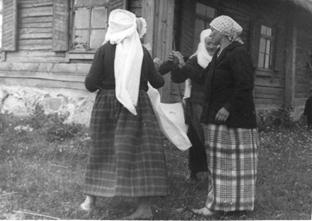
It is a syncretic form of folk creativity, comprising dances, round dances, games and ritual actions with choreographic elements employed. The written historical sources from the 11th–18th centuries for the main part describe the ritual Lithuanian choreographic folklore (performed during weddings, funerals, birthdays, calendar and work festivals), while in the subsequent sources, the disappearing of certain ritual dances and games after the World War I gets pointed at. Historical evidence from the 19th and the first half of the 20th century presents abundant data regarding party dances. The 19th century marks a profound turning point in the development of Lithuanian folk choreography, characterized by the rapid spread of the West European and Slavic dances across Lithuania (e.g. waltz, polka, quadrille, krakowiak, and others), prevalence of instrumental music, and quickening of the dance tempo. In the second half of the 20th century, due to political, economic, social and other changes, the living tradition of Lithuanian folk dances started disappearing, dance parties ceased to be held in the countryside. Dances based on individual creativity and styled in folk fashion, yet considerably distanced from the authentic folk choreography were given the lead. Yet another turn in the development of Lithuanian choreographic folklore occurred in the beginning of the 70s, together with the rise of the folkloric movement, when the authentic choreographic folklore was included into the repertoire of various folk dance groups and ethnographic ensembles. The heritage of Lithuanian choreographic folklore is very diverse. Folk dances of archaic origin used to be accompanied by singing and performed in groups, chiefly by girls and women. As a rule, the character of such dances is level, the steps are simple, low and narrow, with frequent stamping down; the typical choreographic patterns include circles, lines, bridges, stars, willows, snakes, etc.; the figures consist of various kinds of weaving, diving, turning (either around oneself or in pairs), exchanging places, clapping hands, etc. All the typical compositional forms of Lithuanian choreographic folklore are usually characterized by the same quality – the symmetry, manifesting itself not only in the choreographic patterns, figures and movements of dances and games, but also in the music (e.g., double metre, square melodic structure). Dancing solo is fairly uncommon for Lithuanians, except for the old ritual dances, described by the early written sources, the repertoire of the masked carnival personages, and improvisational movements. Such dancing solo either had ritual purposes or was performed for entertainment, but, quite unlike other European traditions, was never meant as demonstration of the dancer’s individual skills. The recorded male dances are rather few, some of them having features in common with other European dancing traditions (e.g., the Mikita dance). The role of men in dancing got enhanced in the 19th century by the spread of the foreign twosome dances and quadrilles, which were usually led by men. The Lithuanian choreographic folklore is further subdivided into the danced (choreographic) sutartinės, games, round dances and dances, although such classification can only be provisional, as discerning dances from round dances and round dances from games is frequently rather difficult. Dalia Urbanavičienė |